
Coffee is one of the most loved drinks around the world. Learning how to say coffee in different languages helps you connect with people from many cultures. A single cup of coffee often brings conversations, friendships, and shared moments.
Understanding the translation of coffee in different languages also helps travelers, language learners, and culture lovers communicate better. From busy cafés in Europe to traditional coffee houses in the Middle East, this word carries warmth and social meaning.
Why Learning ‘Coffee’ in Different Languages Matters
Learning how to say coffee in different languages is more than just vocabulary. It helps build cultural awareness and global communication.
Cultural Value
Coffee traditions vary widely across cultures. In some countries, coffee is a daily ritual, while in others it is part of social gatherings and hospitality.
Global Understanding
Knowing the translation of coffee helps when traveling or meeting people from other countries. Even a small word like coffee can open conversations.
Social Connection
Coffee often symbolizes friendship, meetings, and relaxation. Saying the word in someone’s language shows respect and curiosity about their culture.
Coffee in European Languages
• Spanish — Café (pronounced: kah-FEH)
• French — Café (pronounced: kah-FAY)
• Italian — Caffè (pronounced: kaf-FEH)
• German — Kaffee (pronounced: KAH-feh)
• Portuguese — Café (pronounced: kah-FEH)
• Dutch — Koffie (pronounced:
Swedish : KOF-FAY) — Kaffe (pronounced: KAF-eh)
Coffee in Native American Languages
• Navajo — Gohwééh (pronounced: goh-WEH)
• Cherokee — Kawi (pronounced: KAH-wee)
• Lakota — Pejuta Sapa (pronounced: peh-JOO-tah sah-PAH)
• Ojibwe — Makade-mashkikiwaboo (pronounced: mah-KAH-day-mash-BOke-O
) Kahpih (pronounced: KAH-pee)
• Mohawk — Kafí (pronounced: kah-FEE)
• Hopi — Kapi (pronounced: KAH-pee)
Coffee in Asian Languages
• Chinese (Mandarin) — Kāfēi (pronounced: kah-FAY)
• Japanese — Kōhī (pronounced: koh-HEE)
• Korean — Keopi (pronounced: kuh-PEE)
• Hindi — Kāfī (pronounced: KAA-fee)
• Thai — Kafae (pronounced: kah-FAY)
• Vietnamese — Cà phê (pronounced: kah-FEH)
• Indonesian — Kopi (pronounced: KOH-pee)
Coffee in Middle Eastern Languages
• Arabic — Qahwa (pronounced: KAH-wah)
• Turkish — Kahve (pronounced: KAH-veh)
• Persian — Ghāhveh (pronounced: ghah-VEH)
• Hebrew — Kafe (pronounced: kah-FEH)
• Kurdish — Qehwe (pronounced: KEH-weh)
• Armenian — Surj (pronounced: SOORJ)
• Azerbaijani — Qəhvə (pronounced: kah-VA)
Coffee in African Languages
• Swahili — Kahawa (pronounced: kah-HAH-wah)
• Amharic — Buna (pronounced: BOO-nah)
• Zulu — Ikhofi (pronounced: ee-KHO-fee)
• Yoruba — Kofi (pronounced: KOH-fee)
• Somali — Qaxwo (pronounced: kah-KHO)
• Shona — Kofi (pronounced: KOH-fee)
• Afrikaans — Koffie (pronounced: KOF-ee)
Coffee in Indigenous Languages
• Quechua — Kapi (pronounced: KAH-pee)
• Aymara — Kapi (pronounced: KAH-pee)
• Guarani — Kapi (pronounced: KAH-pee)
• Mapuche — Kapi (pronounced: KAH-pee)
• Nahuatl — Kapi (pronounced: KAH-pee)
• Tupi — Kapi (pronounced: KAH-pee)
• Maya — Kape (pronounced: KAH-peh)
Coffee Lover in Different Languages
Coffee is one of the most loved drinks in the world, and every culture has its own way of expressing love for it. A “coffee lover” can be described differently across languages, but the passion stays the same everywhere.
In English, we say “coffee lover,” while in French it can be “amateur de café.” In Spanish, it becomes “amante del café.” No matter the language, it always represents someone who truly enjoys the taste, aroma, and energy of coffee.
Coffee in Different Languages Reddit
On Reddit, users often discuss how “coffee” is written and pronounced in different countries. People share fun facts about how similar or different the word is across cultures.
For example, in Italian it is “caffè,” in German “Kaffee,” and in Japanese “コーヒー (kōhī).” These discussions show how coffee connects people globally, even if the spelling or pronunciation changes.
Coffee Bean in Different Languages
A coffee bean is the seed that makes your favorite drink possible. Different languages have unique names for it.
In Spanish, it is “grano de café,” in French “grain de café,” and in Arabic “حبوب البن.” Although the names change, the meaning remains the same — the tiny bean that creates a powerful drink enjoyed worldwide.
Brew in Different Languages
The word “brew” refers to the process of making coffee. Every culture has its own way of describing this process.
In German, brewing is “brauen,” in French “infuser,” and in Spanish “preparar café.” These words reflect how coffee preparation is an important ritual in many cultures.
Coffee in Latin
In Latin, coffee is often referred to as “caffea” or “cafea,” which influenced many modern European languages.
Even though coffee was not originally part of ancient Roman culture, Latin became the root for many coffee-related words used today in science and literature.
Espresso in Different Languages
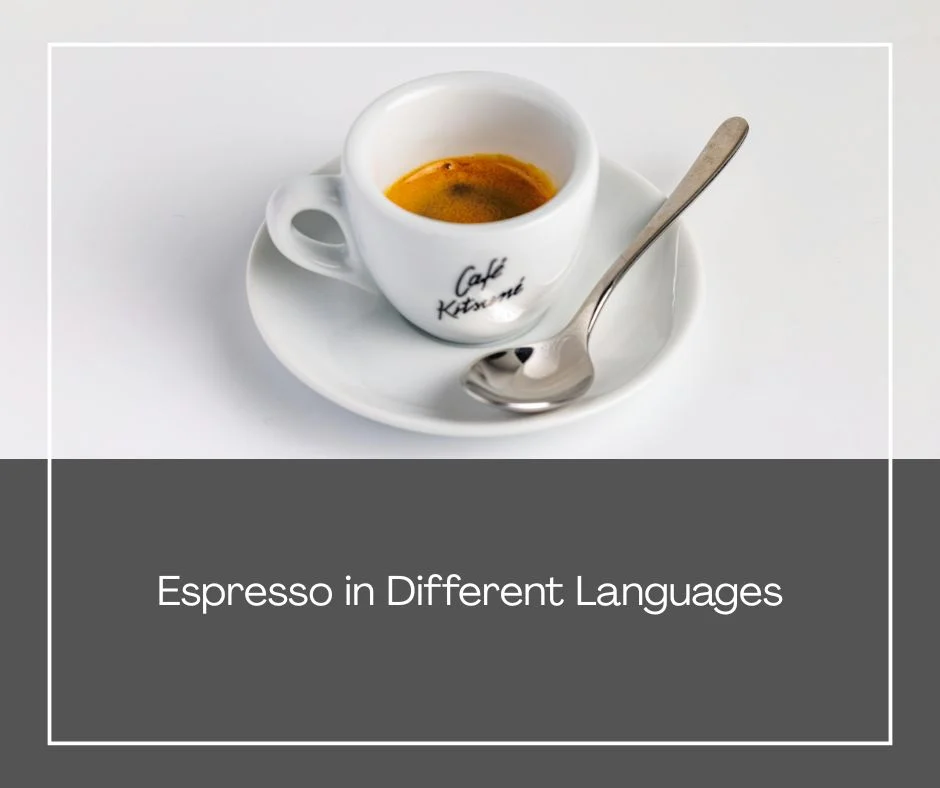
Espresso is a strong coffee style loved worldwide. The word “espresso” is mostly the same in many languages, but pronunciation may vary.
In Italian, it is “espresso,” in French also “espresso,” and in Japanese it is written as “エスプレッソ (esupuresso).” This shows how some coffee terms become global without major changes.
Latte in Different Languages
Latte, meaning milk-based coffee, also has interesting translations.
In Italian, “latte” simply means milk. In English-speaking countries, it became popular as “café latte.” In Spanish, it may be called “café con leche,” which directly translates to coffee with milk.
Caffeine in Different Languages
Caffeine is the natural stimulant found in coffee that gives energy and alertness.
In French, it is “caféine,” in Spanish “cafeína,” and in German “Koffein.” Despite small spelling differences, the concept is understood globally as the energy-boosting element of coffee.
Coffee in Iroquoian Language Family
• Mohawk — Kafí (pronounced: kah-FEE)
• Seneca — Gafi (pronounced: GAH-fee)
• Oneida — Kafi (pronounced: KAH-fee)
• Cayuga — Kafi (pronounced: KAH-fee)
• Tuscarora — Kafi (pronounced: KAH-fee)
• Onondaga — Kafi (pronounced: KAH-fee)
• Huron — Kafi (pronounced: KAH-fee)
Coffee in Plains Languages
• Lakota — Pejuta Sapa (pronounced: peh-JOO-tah SAH-pah)
• Cheyenne — Kapi (pronounced: KAH-pee)
• Arapaho — Kapi (pronounced: KAH-pee)
• Comanche — Kapi (pronounced: KAH-pee)
• Kiowa — Kapi (pronounced: KAH-pee)
• Crow — Kapi (pronounced: KAH-pee)
• Blackfoot — Kapi (pronounced: KAH-pee)
Coffee in Southeastern Languages
• Choctaw — Kapi (pronounced: KAH-pee)
• Chickasaw — Kapi (pronounced: KAH-pee)
• Creek — Kapi (pronounced: KAH-pee)
• Seminole — Kapi (pronounced: KAH-pee)
• Yuchi — Kapi (pronounced: KAH-pee)
• Catawba — Kapi (pronounced: KAH-pee)
• Timucua — Kapi (pronounced: KAH-pee)
Coffee in Northwestern Languages
• Tlingit — Kapi (pronounced: KAH-pee)
• Haida — Kapi (pronounced: KAH-pee)
• Chinook — Kapi (pronounced: KAH-pee)
• Salish — Kapi (pronounced: KAH-pee)
• Nez Perce — Kapi (pronounced: KAH-pee)
• Kwakiutl — Kapi (pronounced: KAH-pee)
• Nuu-chah-nulth — Kapi (pronounced: KAH-pee)
Coffee in Additional World Languages
• Russian — Kofe (pronounced: KOH-feh)
• Ukrainian — Kava (pronounced: KAH-vah)
• Polish — Kawa (pronounced: KAH-vah)
• Greek — Kafés (pronounced: kah-FES)
• Romanian — Cafea (pronounced: kah-FEH-ah)
• Hungarian — Kávé (pronounced: KAH-vay)
• Finnish — Kahvi (pronounced: KAH-vee)
• Danish — Kaffe (pronounced: KAF-eh)
• Norwegian — Kaffe (pronounced: KAF-eh)
• Icelandic — Kaffi (pronounced: KAF-fee)
• Malay — Kopi (pronounced: KOH-pee)
• Filipino — Kape (pronounced: KAH-peh)
• Malagasy — Kafe (pronounced: KAH-feh)
• Haitian Creole — Kafe (pronounced: kah-FEH)
• Latvian — Kafija (pronounced: kah-FEE-yah)
Examples of Using ‘Coffee’ in Sentences Across Languages
Spanish
Word: Café
Sentence: Quiero beber café esta mañana.
Meaning: I want to drink coffee this morning.
French
Word: Café
Sentence: Je prends un café chaque matin.
Meaning: I drink a coffee every morning.
Arabic
Word: Qahwa
Sentence: Uhibbu shurb al-qahwa fi al-sabah.
Meaning: I like drinking coffee in the morning.
Hindi
Word: Kāfī
Sentence: Mujhe subah ek cup kāfī pasand hai.
Meaning: I enjoy a cup of coffee in the morning.
Japanese
Word: Kōhī
Sentence: Watashi wa asa ni kōhī o nomimasu.
Meaning: I drink coffee in the morning.
German
Word: Kaffee
Sentence: Ich trinke gerne Kaffee mit Freunden. Meaning: I enjoy drinking coffee with friends.
Swahili
Word: Coffee
Sentence: I drink coffee every morning.
Meaning: I drink coffee every morning.
Cultural Meaning of ‘Coffee’ Around the World
Coffee has deep cultural meaning in many societies. In some Middle Eastern cultures, serving coffee represents respect and hospitality. Guests are often welcomed with a small cup as a sign of honor.
In Ethiopia, coffee ceremonies are an important tradition where beans are roasted and brewed in front of guests. This ritual symbolizes friendship and community.
In Europe and North America, coffee shops often serve as meeting places for work, study, or socializing. People gather in cafés to relax, share ideas, and enjoy conversations.
Across the world, coffee is not just a beverage—it is a cultural experience that connects people.
Conclusion
Learning coffee in different languages is a fun and meaningful way to explore global cultures. A simple word like coffee carries traditions, emotions, and shared experiences across the world. By discovering how different languages express it, you gain a deeper appreciation for cultural diversity. The next time you travel or meet someone from another country, saying the word for coffee in their language might start a warm and friendly conversation.
