

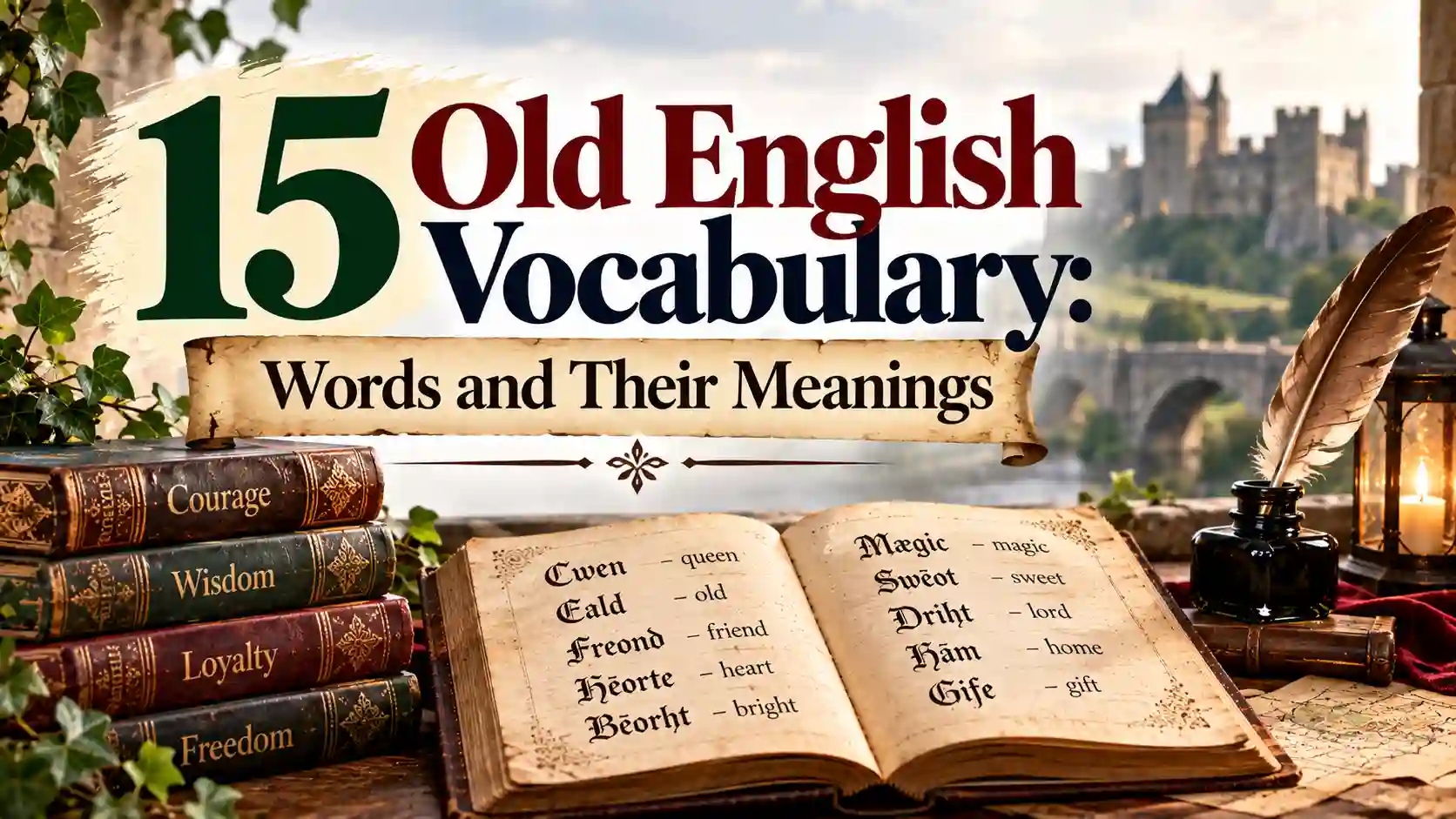
The English language is a living, breathing history book, and nothing captures its evolution quite like Old English vocabulary. Long before the modern lexicon we use today, Anglo-Saxon speakers crafted a language rooted in nature, emotion, and survival. Exploring these 15 historical words offers more than just a linguistic challenge; it provides a window into the worldview of our ancestors. Whether you are a writer seeking inspiration, a history enthusiast, or simply curious about where your favorite words originated, this journey through Old English will deepen your appreciation for the complexity of the English language.
15 Must-Know Old English Words and Their Meanings
Old English, spoken from roughly 450 to 1100 AD, is the bedrock of modern English. Many words have changed in meaning or vanished entirely. Here is an overview of 15 classic terms, their original definitions, and how they bridge the gap to our modern speech.
1. Ealdorman
In Old English, this referred to a man of high status or a chief magistrate. It is the direct etymological ancestor of our modern word ‘alderman,’ which today typically describes a member of a municipal assembly.
2. Bēag
This word translates to ‘ring’ or ‘bracelet.’ In Anglo-Saxon culture, these items were often given as rewards for loyalty, symbolizing the bond between a lord and his follower.
3. Wyrd
Often translated as ‘fate’ or ‘destiny,’ this concept was central to the Anglo-Saxon mindset. It suggests an inevitable power that shapes human life, reflecting their fatalistic view of existence.
4. Gamen
Meaning ‘joy,’ ‘mirth,’ or ‘play,’ this is the ancestor of our modern word ‘game.’ It reminds us that early English concepts of entertainment were deeply tied to the idea of communal happiness.
5. Hām
Meaning ‘home’ or ‘dwelling,’ this term carries a sense of security and belonging. It is a fundamental word that remains largely unchanged in spirit after over a millennium.
6. Gōd
While it looks like the modern word ‘good,’ in Old English it meant both ‘good’ (virtuous) and ‘God’ (the deity). The linguistic proximity highlights the cultural belief that the divine was the ultimate form of goodness.
7. Cniht
This word meant ‘boy’ or ‘servant.’ Over centuries, it evolved into ‘knight,’ shifting from a simple designation of youth or service to a high-ranking military title.
8. Cyning
The literal Old English word for ‘king.’ It is derived from roots related to ‘kin’ or ‘family,’ implying that a ruler was the representative of the people or the kin-group.
9. Scēap
This is the Old English term for ‘sheep.’ The fact that such a fundamental farming word has remained so stable illustrates the agrarian roots of English society.
10. Drēam
In Old English, this meant ‘joy’ or ‘musical sound’ rather than a sleep-vision. The shift to our modern ‘dream’ suggests an interesting evolution in how we conceptualize internal mental experiences.
11. Wīf
Meaning ‘woman,’ this word eventually evolved into ‘wife.’ In historical contexts, it simply referred to a female person, reflecting the social structures of the time.
12. Fēond
Translating to ‘enemy’ or ‘fiend,’ this word is a precursor to ‘fiend’ in the demonic sense. It illustrates how Old English often used intense language to describe adversaries.
13. Mōd
This word meant ‘courage,’ ‘spirit,’ or ‘mind.’ It is the root of the modern word ‘mood’ but carried a much heavier weight regarding a person’s inner strength or temperament.
14. Lēof
Meaning ‘beloved’ or ‘dear,’ this word lives on in the modern ‘love’ and the term ‘lief’ (meaning willingly). It is a beautiful example of how emotional vocabulary has stayed rooted in our speech.
15. Hæleþ
This term meant ‘hero’ or ‘warrior.’ It emphasizes the importance of bravery and physical prowess in Anglo-Saxon poetry and daily life.
Resources to Expand Your Vocabulary
If you are fascinated by the origins of words or simply want to improve your daily command of the English language, these resources are excellent tools to help you build a stronger lexicon.
1000 Powerful English Vocabulary Words

Best For: Beginners and students looking to upgrade their professional communication.
This book is a fantastic guide for learners looking to improve their writing and speaking skills. It focuses on practical, high-impact vocabulary that helps you communicate more effectively in modern scenarios.
Practical Tips: Try picking five words from this guide every day and using them in a short written paragraph to reinforce your memory.
Recommended: Educational Reference
100 Common English Words That Have Different Meanings

Best For: People who want to master the subtle differences in English word usage.
English is full of nuances where one word carries multiple definitions. This book tackles the confusion head-on, providing clarity for common terms that often trip up both native and non-native speakers.
Practical Tips: Use this book to identify words that you frequently misuse, then rewrite sentences using the correct context to avoid confusion.
Recommended: Language Learning/Linguistics
How to Choose the Right Vocabulary Tools
When selecting books to improve your vocabulary, consider your specific goals. If you are interested in history and etymology, look for books that focus on word origins. If you need practical, everyday application, choose guides that emphasize synonyms and contextual usage. Always ensure the book provides examples, as words are best learned when seen in sentences rather than isolated definitions.
Frequently Asked Questions
Is Old English the same as Shakespearean English?
No. Old English (circa 450–1100 AD) is very different from Early Modern English, which Shakespeare used in the 16th and 17th centuries. Shakespearean English is much closer to our modern language.
Why did Old English words change so much?
Language evolves due to cultural shifts, invasions (such as the Norman Conquest), and the natural tendency for speakers to simplify pronunciation and grammar over time.
Final Thoughts
Learning about Old English vocabulary is a rewarding way to see how our modern language was formed. By understanding these 15 historical words, you gain more than just knowledge—you gain a deeper connection to the history of communication. Keep exploring, stay curious, and continue building your own linguistic toolkit to improve how you express yourself every day.
